

“You have to be endlessly trying to build on last week’s work”
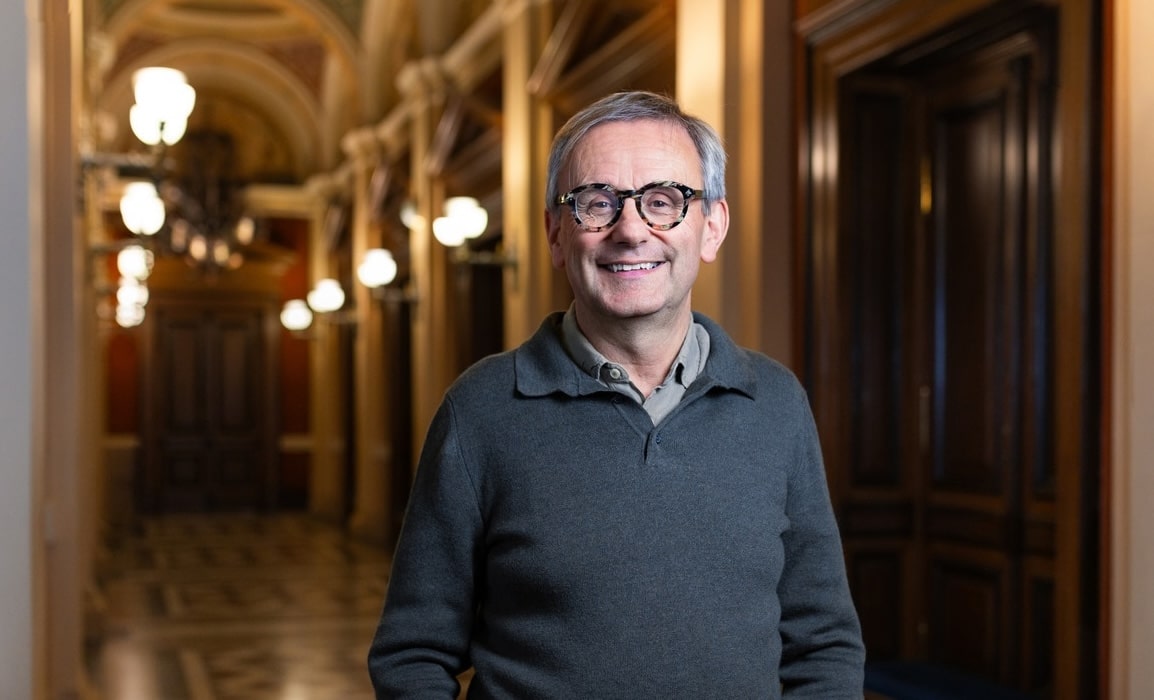
When the Prague Philharmonic Choir decided to invite its first-ever foreign guest conductor, it went straight to the top: Simon Halsey, who is considered the preeminent choral conductor of his time. In a 46-year career, he has worked with many of the world’s greatest orchestras, conductors and choruses, and left his mark as the artistic director of such prestigious ensembles as the London Symphony Chorus and Rundfunkchor Berlin.
Halsey is also an innovator. He has created large-scale choral events that have won great acclaim, inviting audiences to sing along to performances of masterworks like Verdi’s Requiem in Birmingham and Carmina Burana and Handel’s Messiah in Berlin. Those concerts regularly attract over 1,000 enthusiastic participants. Halsey has also led several massive events at Lincoln Center in New York, including the world premiere of David Lang’s the public domain, which featured a choir of 1,000 amateur singers performing outdoors.
While he moves easily in rarefied circles, Halsey is equally happy working with youngsters and amateur singers. He is passionate about promoting singing programs in schools, seeing early in his career the positive impact singing could have on underprivileged children. Halsey recently signed on as artistic advisor and choral director of the Oslo Philharmonic, mainly because the orchestra is building a new concert hall, and much of the building will be devoted to facilities for education and training.
Halsey spent a week and a half preparing the Prague Philharmonic Choir for Il prigioniero, a one-act opera composed in the late 1940s by Luigi Dallapiccola. Born from the ashes of World War II, it tells the harrowing story of a nameless prisoner being held during the Spanish Inquisition who is on the verge of escape when a tragic reversal brings a different kind of freedom – his death. An atonal piece written in the 12-tone style created by Arnold Schoenberg, it is particularly difficult to perform. Halsey did it with Maestro Antonio Pappano under adverse conditions in London in 2022, setting the stage for their reunion in Prague.
Halsey was interviewed at the Rudolfinum on 25 November 2025, the day before the performances of Il prigioniero with the Czech Philharmonic began.
You’ve spent most of your life as a choral singer and conductor. How did you originally come to choral music and then choose it as a profession?
Through my father, Louis Halsey, who was one of the leading choral conductors of his generation. He founded a fantastic choir called the Elizabethan Singers that performed in London throughout the 1950s and ’60s and recorded a very wide repertoire for Decca. He commisioned 250 new works and acted as an assistant and choirmaster for composers like Benjamin Britten, Vaughan Williams and Igor Stravinsky.
My father started out doing the absolutely traditional British thing, singing as a cathedral choirboy and then in the King’s College Cambridge choir. I was sent to be a cathedral choirboy and then also joined the King’s College choir, so I followed in his footsteps exactly. In addition, my mother was a singer in his choir and a music teacher. Later on, she became a very distinguished teacher of conducting. So there was no escape for me.
Were you familiar with the Prague Philharmonic Choir before you came to work with them on this project?
Yes, they’re very famous, I know all about them. I have many of their recordings, and I heard them at the BBC Proms last year. In many ways they are the exact equivalent of the Rundfunkchor Berlin that I ran from 2000 to 2015, the same model of working with different orchestras. So I am very familiar with the concept, and the level of distinction and quality of the voices. It feels like a family that I know.
That said, at this time last week I was extremely nervous about coming here and am feeling very privileged to be here at all. I wondered: Will I make a connection with these people? Will I bring something they want and need? The piece we are doing is very difficult and demanding, how will it be with the orchestra? Just this morning as we were beginning rehearsal I said to Kateřina [Zikmundová], “I’m as nervous as I was when I was 21 – and I’m 67!”
It’s surprising to hear one of the world’s foremost choral conductors say that he’s nervous about working with a new ensemble.
The day you stop being nervous, it’s time to retire. Take a piece like Faure’s Requiem or the Messiah – the choir can read it and give a decent performance from day one. So then the question becomes, how can we make it wonderful? How can we do a better job today than yesterday? Because if you don’t do that as professional musicians, you begin to go down and become complacent. You have to be endlessly trying to build on last week’s work, which is an extremely tiring job, but one that Lukáš [Vasilek] does so fantastically here.
How much preparation have you done for Il prigioniero?
Three days last week just with the choir, the first day separately with the men and women – that gave me a smaller number of people in the room, so I could really listen and work with them. On Sunday we had a piano rehearsal, and this week we’re rehearsing three days with the orchestra. Then I’ll be at all the concerts, taking notes, because there’s a warm-up before every concert and we’re trying to make each one better.
You’ve done this piece before?
Yes, with Antonio Pappano and the London Symphony Orchestra in 2022. It was a bit awkward, because we were still coming out of COVID, and the orchestra understandably did not want the choir onstage, breathing on them. So we had the choir up in the third gallery. Pappano only conducted the orchestra, and I conducted the choir from 60 meters away, but I think it all came together properly.
How do you see the piece?
It’s a story of political oppression set during the Spanish Inquisition but universal in its themes of totalitarianism and cruelty, and in some ways closely related to life here – Kafka and 1945 and 1989. It’s a shocking story, and what’s most shocking is that it’s expressed so quickly, in just 45 minutes. And the choir has only 10 minutes in that! Its role is terribly minimal, and the notes are extremely difficult, because it’s 12-tone music.
Has that been a problem for the choir?
No, it’s been wonderful to work with them, because they are technically capable of doing this. Overall, it’s been a very good experience. They are very disciplined, and they’ve been very friendly and welcoming. They are singing with great energy and great distinction, so I’m having a very nice time.
I just hope that I’m giving them something different or worthy or extra from their normal work. I’m a guest, like the grandfather who comes in and plays with the children, and then leaves. Lukáš is the one doing all the hard work.
What have you been focusing on in rehearsals?
I work very technically and with the greatest possible rhythmic precision, like exactly where the consonants go at the end of a phrase. We did a lot of work on pure vowel sounds, making sure that all 80 singers match each other – the basses are high, the tenors are comfortable, the altos are low – because if they don’t, then we cannot have good sound or intonation. Also: Is everybody listening, from one side to the other? Are we breathing at the same time? Are we feeling an internal pulse?
You might think these are things that a professional should know. And they do. But the really great choirs and orchestras work endlessly on these technical details.
What challenges have you faced?
Well, the orchestra is new to me, the hall is new to me and the acoustics are new to me. But fortunately I was here for the Velvet Revolution anniversary concert last week, so I heard the orchestra and the choir in the hall two days before I started working with them.
What’s challenging about the piece is that some passages are fortissimo, where the composer says to perform as loud as possible, but most of the piece is quadruple piano, where you have to be as quiet as possible. Here, let me show you some of the notations [flips through the score]:
“with great tenderness”… “almost unconscious, whispering”…“every spectator must feel himself overwhelmed and submerged by the immensity of the sound.” So we have to do the loudest playing and singing ever experienced, and the quietest ever experienced – and for the choir, all in just 10 minutes!
Can you get the expression you want in a difficult piece like this?
Yes, we got it today. And the storytelling has to be done with your eyes as well as your voice. The one thing I will never allow is this [buries his face in the score and sings without looking up].
Have you spent much time in Prague?
I’ve never been to the Czech Republic before, even though my family lives in Dresden. So this is my first time in Prague, and I love it.
The two major places in my life have been the United Kingdom and Germany, both of which had their major cities destroyed during the Second World War. You go to a place like Cologne now and it’s been rebuilt as just a big concrete city, it could be Minneapolis. Here, you have the enormous privilege that your city was not flattened and destroyed. To be able to see what our forefathers actually built is amazing.
The other really interesting thing is that you have not allowed skyscrapers to be built here. In London, you can still find a small church built by Christopher Wren, but right next to it is a thousand-meter-high glass box. I don’t mean to be negative about London, but what you have in Prague is very special.
Music is more than just music here, it’s part of the cultural identity. Do you sense that?
That is very clear, very clear. And there are so many other things that I feel uniquely here.
After living in Berlin for 15 years, I understand everything about 1989. My choir there had been the East German Radio Choir, and in 1989 they all came through the wall to sing in the Beethoven Ninth that Bernstein conducted. That was their first time in the West. Then afterward they went back home to the East to sleep.
I can feel the traces of communism here as well. There’s a mixture of history, and it’s very interesting to me, such an intriguing mixture. And the people are so friendly, which I also find quite interesting.
text by Frank Kuznik
Frank Kuznik is the former Editor-in-Chief and Culture Editor of The Prague Post, Central Europe’s premier English-language weekly newspaper. He currently divides his time between Prague and his hometown in the US, Cleveland, where he covers northeast Ohio’s dynamic classical music scene. In Prague he is an habitué of the Rudolfinum, National Theater, State Opera and other storied classical music venues, and an unabashed fan of Czech music.