

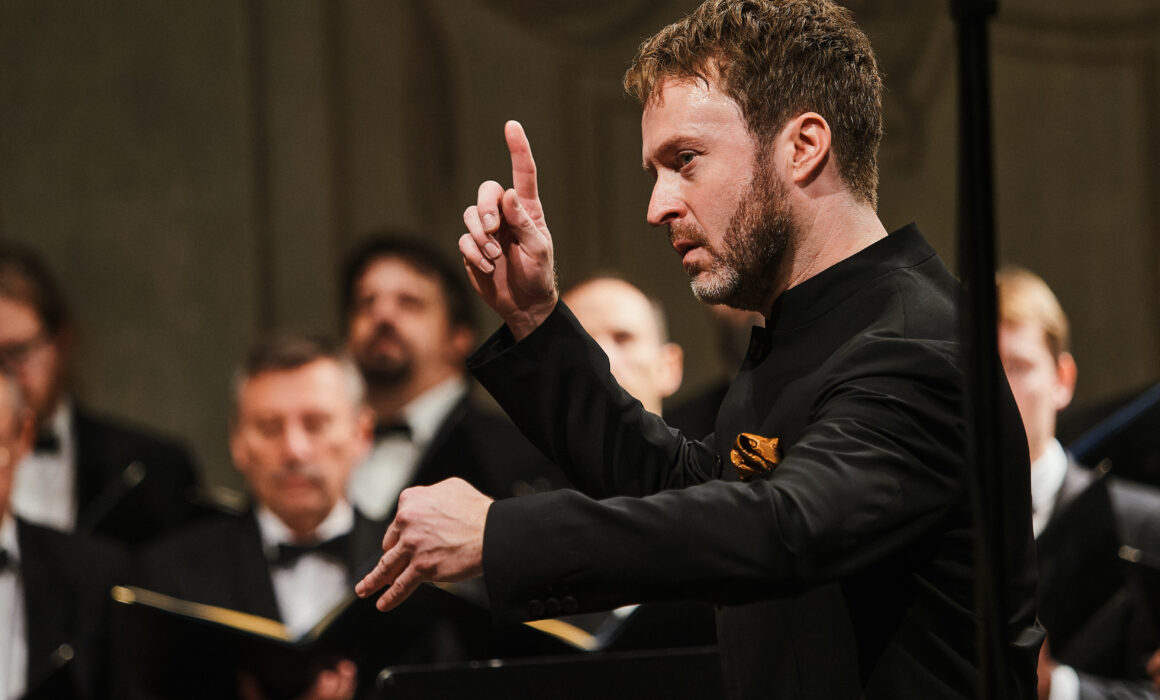
Lukáš Vasilek: Joan of Arc captivates immediately from the start
5 February 2025, Klasika+, Jan Sebastian Tomsa
In 2007 you were appointed principal choirmaster of the Prague Philharmonic Choir. What do you consider to be the greatest success of this ensemble under your direction?
We understand each other artistically and pull together. Without this no choir can work properly. Perhaps I am being too self-confident, but I think that it can be seen and heard.
In addition to countless collaborations, the Prague Philharmonic Choir also presents a series of a capella concerts during which it also performs contemporary classical music. How do you choose contemporary composers?
There are more of these aspects. It must be a composition which we are able to study timewise and technically. In addition, I like to be sure that it fits the singers and me, we will enjoy it and will get something from it. This is then very noticeable in the result. I also consider the space in which the concert is performed and whether that composition fits there or not. And we must of course think of the audience. The aim is not to annoy or demotivate listeners. We want the music to give them something – to address or entertain them, so they like or are moved by it and come to our concert again.
In your opinion what criteria must contemporary music meet so it has the potential to assert itself, to take hold?
It should have such content and reach that it draws the performer and audience in and doesn’t let go. And it doesn’t matter at all how complicated is the compositional style it represents. The audience will manage to absorb any sort of complicated music if it understands what the composer wants to say.
Is there any kind of choir work which you have always wanted to study, but you never got around to it? Do you have any choirmaster-conductor dream?
There is lots of good music which I would enjoy or look forward to. But I cannot think of one specific work right now. I like discovering new things as they come. And I like the moment of surprise – perhaps when an unexpected offer comes along, which has the potential of changing my whole musical direction and thinking. It happened many times in my life that I have had these twists and turns, which occurred without my intervention, have brought me the most. Such moments are the most precious to me. And therefore I have long since stopped dreaming, it is a dead end for me.
Describe to us what led to your forthcoming debut with the Czech Philharmonic. Can you outline this path? Who or what decided that you will have your debut with Joan of Arc? It is difficult to imagine a more challenging composition for a conducting debut…
This all relates to a totally different composition which is Britten’s War Requiem. This is a similarly challenging score which we performed for the first time two years ago. It was a success and we all enjoyed it together. And it was on this basis that the leadership of the choir began to consider what would come next and what direction we should take. In the end we said that we would maintain the direction, so then it was only a small step to Joan of Arc. The fact that this project will finally take place with the Czech Philharmonic is a huge honour which I appreciate. And a challenge of course. Yes, Joan of Arc is challenging, but there is no need to demonize it so much. The musical structure itself is brilliant and highly diverse, but certainly not elusive. The complexity of this work involves coordination of all components of the huge ensemble – actors, singers, instrumentalists – and maintaining one stroke from start to finish. The point is that the composition does not fall apart within its diversity into very small fragments.
Do you have experience as a choirmaster in performing Joan of Arc?
Yes, I have studied it twice with the Prague Philharmonic Choir, but that was quite a while ago. However, the experience is very important – I could try out the composition from the other side. Even more important for me was that I could conduct Honegger’s other oratorio, King David, several times. It may be a less complicated composition, but it was essential to get under the skin of Honegger’s style.
Can you share your emotions and impressions of this monumental (and beautiful) work?
Joan of Arc is simply brilliant and captivates you immediately from the start. Honegger’s music in full unison with Paul Claudel’s text (both are of totally exceptional quality) created a perfect artistic form. There is little that can compare with Joan of Arc.
Did you have the opportunity of hearing the interpretation of Joan of Arc by Serge Baudo, which is presented as a reference?
Baudo’s recording of 1974 was ground-breaking in its time – there weren’t many recordings of Joan of Arc at the time and certainly not of such artistic and technical quality. Even after fifty years, it’s definitely worth listening to! And in my opinion Nelly Borgeaud is perhaps the best Joan – her performance is almost indescribable. Of course, what is also interesting is that the Prague Philharmonic and Kühn Children’s Choir sing while it is the Czech Philharmonic that plays on this recording. So it’s the same cast that we will have at our concerts. I really like Seiji Ozawa’s recording – it is very mercurial and perfectly describes the dramatism of this story. Of the newer recordings, Marc Soustrot’s is a really good recording which has a somewhat more lyrical approach, perhaps a little more like Honegger’s score. And has a very interesting Joan – the Oscar star Marion Cotillard.
Who do you think has the most fundamental role in this work? The choirs, orchestra, soloists or the reciters?
Everyone at once. Here one cannot work without the other as all the performers are organically interconnected so this is literally a symbiosis.
Could you in some way manage to describe or define Arthur Honegger’s musical language?
Concise, direct, beautiful, colourful, original, recognisable.
Are you happy to be a conductor and choirmaster?
If I knew… I’m just where I am. Somehow life threw me into this role and I stayed in it. But I definitely enjoy it and it makes me happy, although of course the work also brings very challenging moments. I’m not the type of person to claim it’s my mission, my fate that I couldn’t or didn’t want to do anything else. I would love to do something else if that were to be the case and like it just as much. I hate one-sidedness, because over time it always begins to descend into stupidity. Hopefully it won’t affect me.
Can you remember the moment you fell in love with music?
That was certainly at home in Hradec Králové. I was supported in my love of music by my parents from an early age. At the age of five I began to learn to play the piano, a little later I began to sing in the boy’s choir Boni pueri. This is how I started.
Do you still sing or do you try to shape music from the other side of the stand?
I don’t sing, everyone around me sings better than me. But I often pre-sing at choir rehearsals to demonstrate my idea of the music and sound to the singers. The choirmaster cannot work without it.
Do you have any rituals or special requirements before a performance?
I don’t really have any rituals as such. But if I can, I have a shower and have a little something to eat to get some sugar inside me. I also like to get changed into my concert suit well in advance. It calms me down and lowers my stress in thinking that I won’t have time to relax before the concert.
How do you maintain your mental health?
Dog, cottage, nature, hiking, bike, skis, swimming, book, film. No music at all.